Restoring Waiwhero: A Catchment Pilot Project
You may already be familiar with Kotahitanga mō te Taiao (KMTT) https://kmtt.org.nz/, NZ’s largest collaborative restoration initiative. Working across 3.4 million hectares of land and ocean in Te Tauihu ō te Waka ki Kawatiri (the Top of the South and Buller/Westport), KMTT brings together iwi, councils, government agencies, communities, and environmental organisations to restore and protect the region’s natural environments.
Through community-led partnerships, KMTT supports projects that restore forests, wetlands, waterways, and coastal ecosystems, embracing the principle of ki uta ki tai – from the mountains to the sea. The alliance includes nine iwi: Ngāti Apa ki te Rā Tō, Ngāti Koata, Ngāti Kuia, Ngāti Rārua, Ngāti Tama, Ngāti Toa Rangatira, Ngāti Waewae, Rangitāne, and Te Ātiawa; five councils: Buller District Council, Nelson City Council, Marlborough District Council, Tasman District Council, and West Coast Regional Council; along with the Department of Conservation, Ministry for the Environment, and Fisheries New Zealand.
One of KMTT’s key initiatives, the Restoring Lowlands Project, is investigating how fragmented lowland ecosystems across Te Tauihu ki Kawatiri can be restored more effectively, affordably, and at a scale that delivers long-term environmental, cultural and social benefits. Under an agreement with KMTT, The Nature Conservancy Aotearoa New Zealand (TNC NZ) is leading the Restoring Lowlands initiative, working collaboratively with KMTT partners and the wider community to conduct a feasibility study to explore opportunities for scaling native reforestation in ways that help landowners meet their own aspirations while enhancing biodiversity, reducing erosion and sedimentation and building climate resilience.
The project aims to restore native vegetation cover to 15% across the fragmented and depleted lowlands of the tri-catchment area of the Motueka, Moutere and Riuwaka catchments. To support this vision, the project team is exploring partnerships, cost-sharing models and restoration methodologies at a range of sites to trial restoration approaches that could later be applied more broadly.
At a local level, the Waiwhero Water Monitors had begun exploring opportunities to restore the Waiwhero Wetlands, an area once rich in biodiversity. Environmental DNA (eDNA) testing undertaken in 2023 rated the creek as Poor, while monitoring carried out by the Motueka Catchment Collective (MCC) and Tasman Bay Guardians during the summer of 2025-26 identified Waiwhero as the warmest of eleven tributaries surveyed. In response, the Water Monitoring Group and MCC organised a community meeting for local landowners to discuss future restoration opportunities.
Growing interest in the Waiwhero Creek and Wetlands – Motueka Catchment Collective
With collaborative agreements already in place between TNC NZ and Te Tauihu Environment Trust (TET), and between TET & MCC, connecting the aims of the Waiwhero community with the broader objectives of the Restoring Lowlands project was a natural step.
MCC’s Lucy Maxwell, a Waiwhero landowner and member of the Water Monitoring Group, highlighted the catchment’s reforestation opportunities and biodiversity potential. Restoration efforts could improve wetland habitats, supporting the return of giant kōkopu and encouraging populations of fernbirds and other native species.
With strong community engagement already underway, the Waiwhero sub-catchment was identified as a strong candidate for local restoration trials for the Restoring Lowlands project in support of outcomes at regional scales. The Waiwhero catchment provides an ideal pilot site, reflecting many of the characteristics found across the wider Motueka-Riuwaka catchment, including farms, lifestyle blocks, commercial forestry, orchards, clay soils, and Separation Point Granite geology.
Since the start of the collaboration in May, Lucy has been working closely with farmers and landowners to identify planting & other restoration opportunities and understand the challenges they face. She has been supported by Elliot Easton, KMTT Project Coordinator, whose experience and practical knowledge have been invaluable to the project.
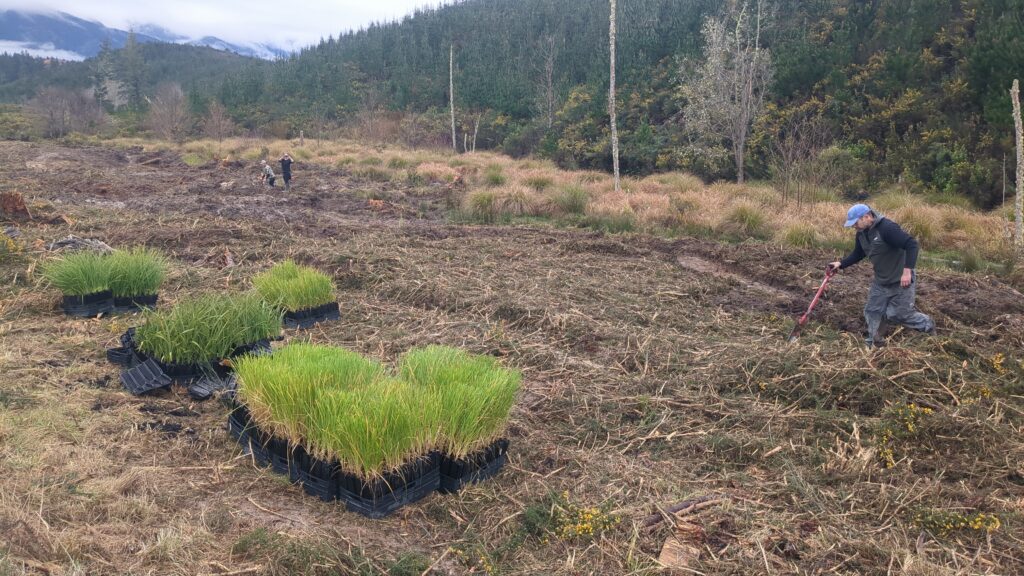
Among the most enthusiastic participants have been Jolene and Brendan Horrell, who have already undertaken significant restoration work on their property and were eager to expand their efforts. They engaged Byron McEnroe (“Dr Dig”) to mulch a large area of gorse alongside wetlands in the Bogie Valley. The site has previously recorded giant kōkopu, and fernbirds have also been heard nearby.
Following the mulching work, Lawson Davey from Fish & Game visited the site to provide advice on habitat restoration, with a focus on creating ideal conditions for giant kōkopu. The project was also able to secure eco-sourced native species, including a large proportion of Carex grasses & other wetland suitable plants from Pete Taia at Westbank Natives, ensuring locally appropriate planting stock.
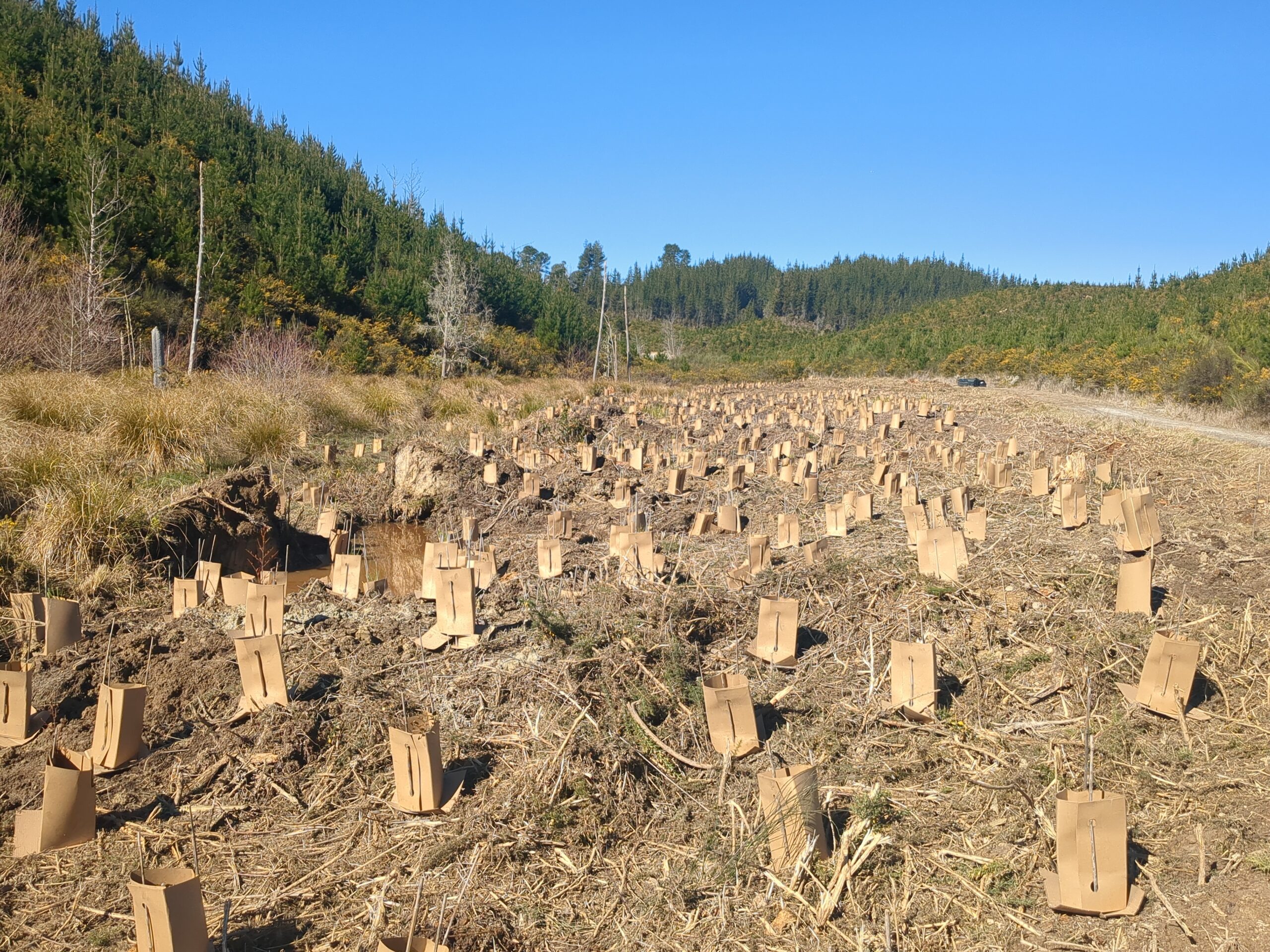
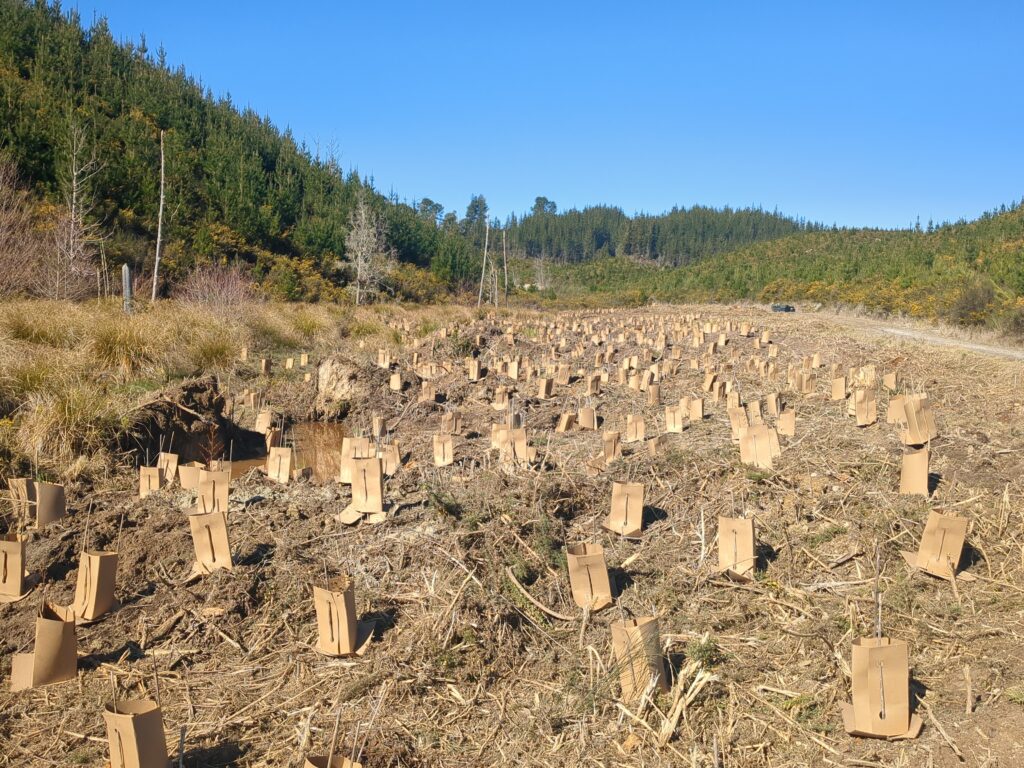
After months of planning and discussion, the first stage of planting was completed remarkably quickly. The newly established plants have been protected with guards & mulch plates & the mulched gorse is acting as a natural shelter. Looking ahead, once the gorse resprouts in spring, targeted weed control will be carried out, followed by a second round of planting that will introduce larger shrubs, toi toi, and trees further back from the wetland margins. These species will eventually provide the shaded, cool stream habitat favoured by giant kōkopu.
The Waiwhero Project will continue through to the end of 2028, with approximately nine additional hectares planned for restoration planting. Lucy and Elliot have been working closely with Tasman District Council’s Catchment Team members Helen Forsey and Heath Melville, while also engaging with Ngāti Tama and Forest Management Group, who own & manage the forestry within the catchment.
The project highlights the power of collaboration, bringing together landowners, iwi, councils, environmental organisations, and government agencies to maximise restoration outcomes. Through this collective effort, the project is supporting Waiwhero residents to improve the health of local waterways and wetlands plus contributing to KMTT’s wider lowland restoration goals.
We look forward to sharing more updates as the project progresses.
Previous Story