Letting nature return
Assisted Natural Regeneration: A Smart Approach to Restoring parts of Our Catchments
By the Biodiversity & Restoration Group, Motueka Catchment Collective.
Assisted Natural Regeneration (ANR) is about working with nature to restore native ecosystems. This method supports the natural recovery of native plants by reducing disturbance, nurturing existing seedlings, and minimizing competition from weeds and pest animals. In some cases, it may also include enhancement planting to boost biodiversity.
All of our catchments have areas where ANR could be feasible, but it is especially promising in the Motueka catchment, where the Biodiversity and Restoration Group is eager to learn and support this process. If you have knowledge, experience, or examples of ANR, we’d love to hear from you—contact MCC and share your insights.
Recently, several members of the Motueka Catchment Collective attended a two-day workshop on assisted native restoration, led by Adam Forbes, a renowned ecologist and researcher from Forbes Ecology. The workshop was incredibly valuable, and Adam plans to run it again possibly locally but throughout New Zealand. This article highlights just a few key learnings from that event—insights that can help us all move toward more resilient, thriving landscapes.
Why Natural Regeneration Matters
ANR is more than a restoration technique—it’s a movement toward resilience. It taps into the land’s own potential, using our local seed banks, bird dispersal, and microclimates to rebuild ecosystems. When we assist these processes—by fencing out stock, controlling weeds, and reducing browsing pressure—we accelerate recovery and help create forests that withstand strong storms, slow down water flows into our rivers and mitigate erosion, and all of these helps us to adapt and slow climate change.
Where Does Natural Regeneration work best.
- Read the Land: Every site tells a story. Look for what is already naturally regenerating, are there seed sources, are there different microclimates that will need different plantings.
- Aspect and Climate Matter:
- South-facing slopes and sheltered gullies often regenerate faster than exposed north-facing ridges.
- We are lucky with our rainfall and temperature which set the pace for regeneration —sites with >1,200 mm annual rainfall and mild temperatures regenerate more quickly, while dry or frosty areas may need extra help.
- Birds Are Key:
- Birds are the main seed dispersers and nutrient carriers. Kererū (wood pigeon), tūī, and bellbirds are critical for spreading native seeds.
- Without birds within, regeneration slows dramatically – healthy bird populations mean healthy forests.
- Seed Source Distance:
- Regeneration potential drops sharply beyond 200 m from native forest edges and is almost negligible beyond 1 km. If your land is isolated from native forests enrichment planting or seed islands may be essential. And if you don’t have the patience to wait 30 years for the large podocarps they could be added.
- Remove Barriers: Weeds and animal pests are the biggest roadblocks—deal with them early.
- Work With Light: Shade and sun drive succession. Nurse crops like gorse can help but manage them wisely. For example, if you are planting into 4 m gorse an ideal light well for a native tree is 2.4 m.
- Monitor and Adapt: Success isn’t instant—it’s a journey. Track stem density and type, canopy cover, and species diversity.
Weeds: Friend or Foe?
Not all weeds behave the same. Some help early; others hinder forever.
- Facilitators (Short-Term Help): Gorse can act as a nurse crop, creating shelter for natives—and will be eventually shaded out by the native trees.
- Persistent Competitors (Long-Term Problem): Shade-tolerant weeds like old mans beards and climbing asparagus, persist under canopy and choke regeneration.
- Structural Dominants: Wilding pines may provide shade initially but will ultimately outcompete natives for light and space.
Tip: Control shade-tolerant and structural dominants early. Use facilitative weeds strategically, but plan for their removal before they become a hazard.
Local Success Story: Richmond Hills
After pine harvesting in 2020, Tasman District Council faced a daunting challenge: 120 hectares of steep land above Richmond where the income from forestry along with logistical challenges around harvesting the trees and the downstream impacts on storm water made it not sensible to replant in forestry. Instead of defaulting to full replanting, they leaned into natural regeneration.
- What worked?
- Aspect advantage: South-facing slopes and gullies provided shelter and moisture, speeding up native recovery.
- Existing seed sources in gullies gave a head start.
- Bird activity: Kererū and tūī helped spread seeds from nearby remnants.
- Gorse acted as a nurse crop, sheltering native seedlings like mahoe and akeake which have established well.
- Targeted interventions—weed control, enrichment planting, and pest management—kept succession on track. There were minimal grazing animal pests because of the neighbouring properties were doing a good job on goats, deer and pigs. Hares were an issue and mitigated by using plant guards.
Five years later, the results speak for themselves: thriving native cover especially strong mahoe growth, gorse cover, and developing resilience against stormwater impacts. This approach saved costs, reduced soil disturbance, and created a living example of how nature, when supported, can heal landscapes.
.
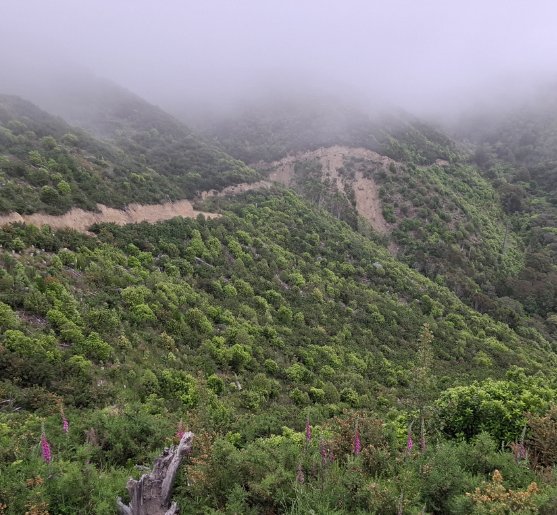
Do you have an area of Land you want to Revert Back to Native Forest?
Now is the time to act. Start by walking your land—look for seed sources, regenerating seedlings and check slope and aspect, and assess weed and pest pressure. Even small steps like fencing, controlling browsing animals, and protecting existing natives can set regeneration in motion. Are you on this journey and want to share and receive knowledge reach out to the Motueka Catchment Collective and we can link people together for advice and support. This is an area the Biodiversity and Restoration Group has highlighted for action in their section of the Motueka Catchment Mangement plan
Natural regeneration is not passive—it’s proactive stewardship. Every hectare we help regenerate is a gift to future generations: stronger landscapes, richer biodiversity, and a legacy of care. Let’s read the land, remove the barriers, and trust nature’s genius.
Contact: Annette Litherland, NZ Landcare Trust, BAR Group, Motueka Catchment Collective. annette.litherland@landcare.org.nz 027 7244445