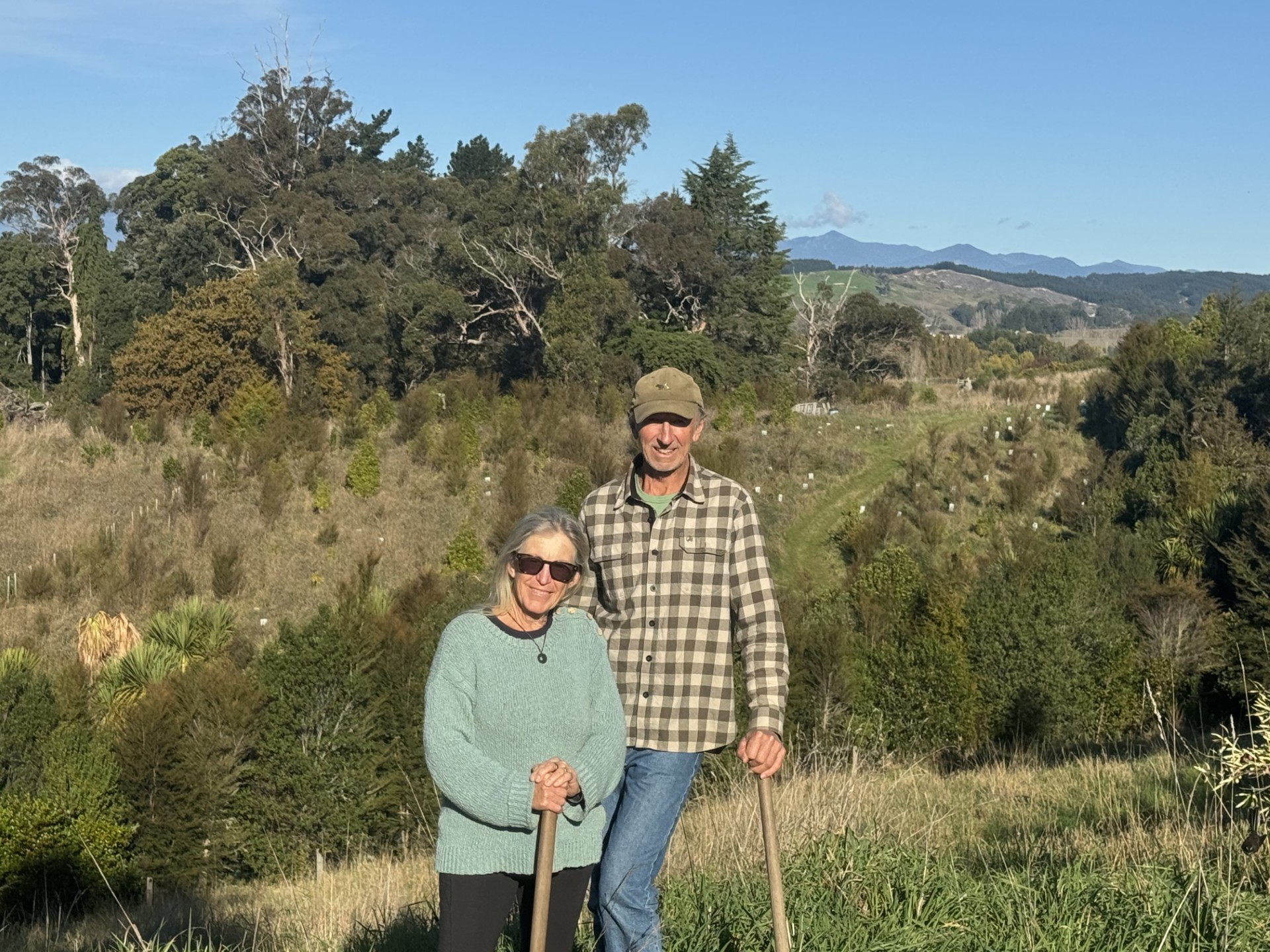
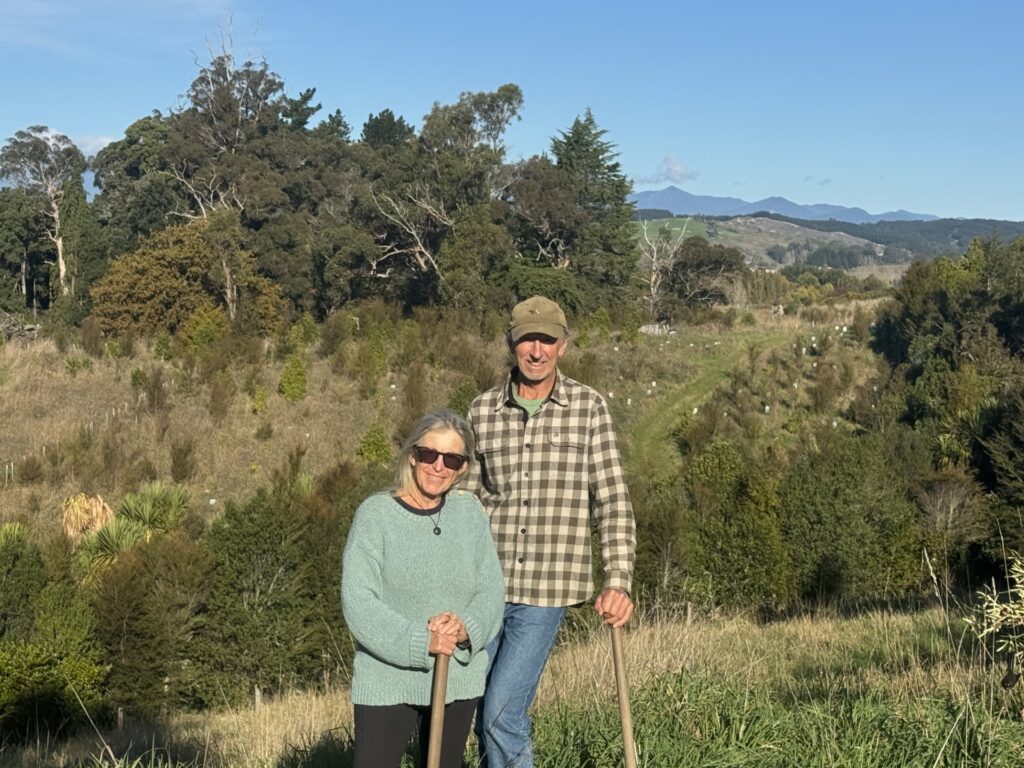
Growing a Forest: Fiona and Alastair’s Restoration Journey
When Fiona and Alastair bought their 12.5 hectare farm in 2010, they saw themselves as kaitiaki of a unique piece of Aotearoa’s history. A 0.7 hectare native forest remnant near the old farmhouse offered a glimpse of the extensive beech and podocarp forest that once covered the Moutere Gravels — a geologically significant landscape. That remnant became the green heart of the property, and the starting point for a restoration journey that continues today.
In 2011 they covenanted the area with QEII National Trust protection, following a Tasman District Council commissioned report noting threatened species including scarlet and yellow mistletoe in ancient black and silver beech trees. Botanical surveys by Martin Heine of TET, and Fiona’s brothers Geoff and Simon Walls, identified white maire, gastrodia and greenhood orchids, and a rich diversity of carex and coprosma. Armed with this knowledge, Fiona and Alastair began the gargantuan task of removing exotic weeds — blackberry, Himalayan honeysuckle, banana passionfruit, ivy, holly and hawthorn.
In the family
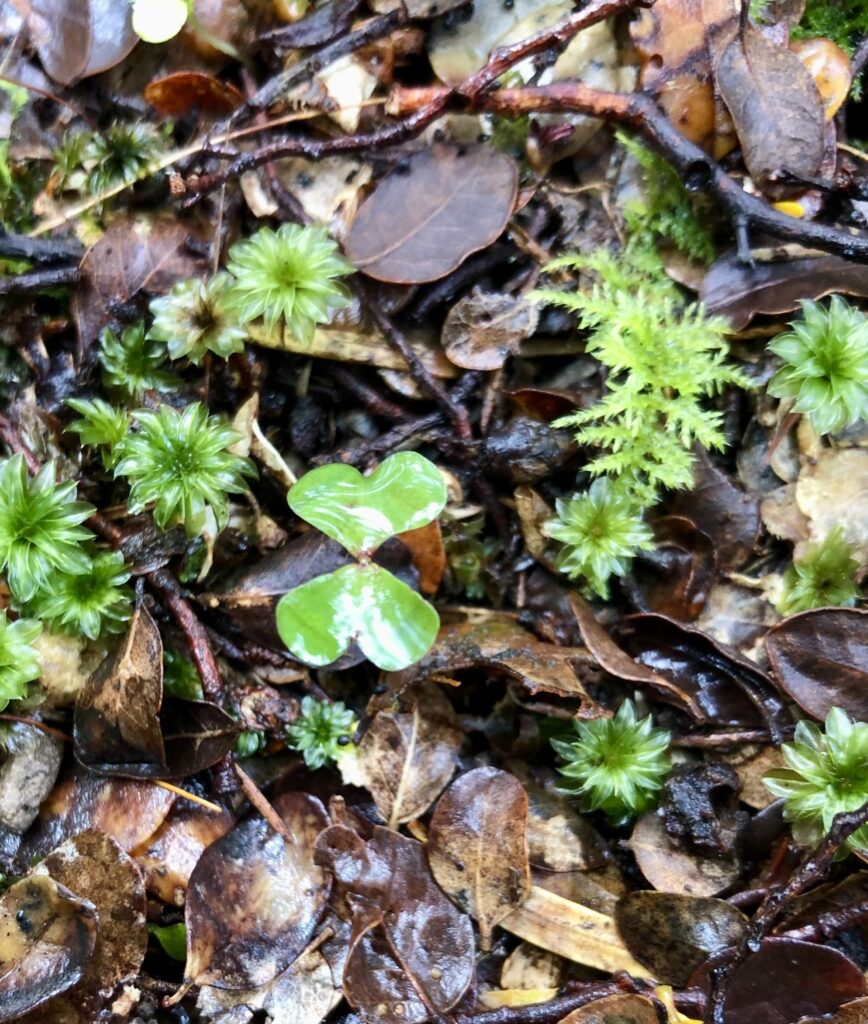
Fiona’s connection to the land runs deep. Her late brother Geoff, an ecologist with the DSIR, published a comprehensive study of native forest remnants across the Moutere Gravels in 1985 — a document Fiona still consults regularly. Her younger brother Simon, a DOC biodiversity ranger and 2022 recipient of the Loder Cup, advised that the remnant was vulnerable to the “edge effect” — insufficient canopy leading to desiccation and breakdown of natural regeneration. He recommended perimeter buffer planting and enriching the forest floor with carbon in the form of logs and branches to encourage fungi, ferns and mosses.
Buffer and riparian planting began in 2013. The gully below the remnant is now transitioning rapidly into rich, shady habitat, with ferns and carex taking hold naturally, their seed washing down from the forest above.
From pasture to forest
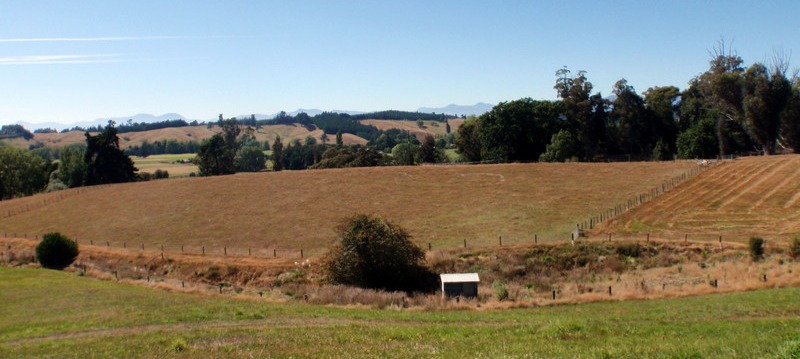
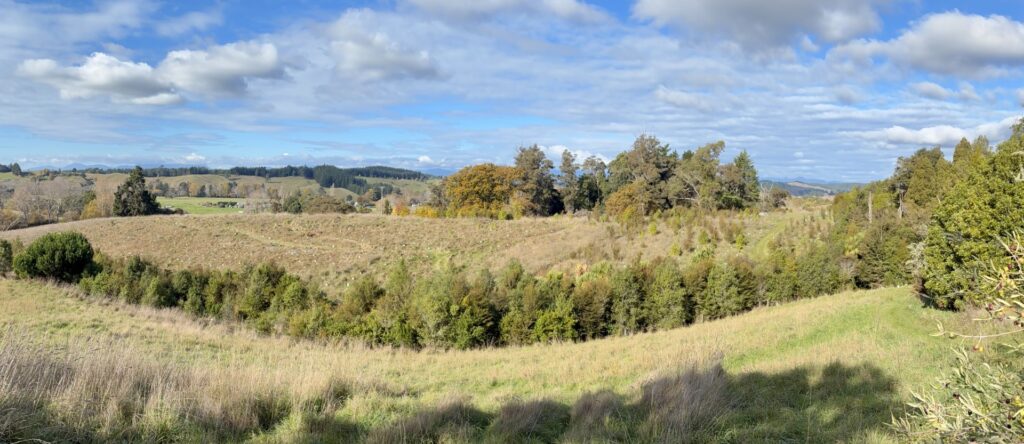
In 2019, Fiona and Alastair made a momentous decision: to switch from farming animals to farming a native forest. Supported by One Billion Trees funding, active planting of the first block began in 2020. By 2022 the cows were gone. Today, 8 hectares of former pasture is steadily transitioning toward forest.
Understanding forest succession
A key lesson has been that forests don’t appear fully formed — they assemble over time. Pioneer species like cabbage trees, mānuka, kānuka, pittosporums and harakeke play an essential early role, stabilising soil, building leaf litter, attracting birds and insects, and creating shelter. Fiona and Alastair initially worried about competition from grass, but now recognise how critical it is for insect and skink habitat, nutrient cycling and soil protection in the early stages. They’ve also made compelling use of existing gorse and broom as nursery plants for young natives.
Two other factors have proven critical: access to healthy seed sources nearby, and effective pest control. On-site, the difference between areas with rabbit exclusion fencing and predator trapping, and those without, has been stark — a reminder that restoration success can hinge on what isn’t immediately visible.
Birds, soil and the long game
Kererū are the heavy lifters of forest regeneration — the only birds capable of dispersing large seeds such as miro. Research shows birds typically drop seed within 200 metres of where they feed, so restoration plantings don’t need to sit beside remnant forest, but they do need to be connected.
Underground transitions are equally important — and slow. Forest succession rarely accelerates until sufficient leaf litter builds up, which on heavily grazed land can take decades. Even 12-year-old planted native forests often still have bacterial-dominated soils, a reminder of how patient restoration must be.
Light management is another ongoing consideration. Between five and ten years after planting, dense uniform canopies can block light and stall regeneration. “To replicate the patchiness of a natural forest, we sometimes selectively cut and drop vegetation to create light wells,” says Alastair. A useful rule of thumb: light wells should be about 60% of the surrounding canopy height.

A forest in the making
Monitoring has been central throughout. Botanical surveys in 2017 and 2024 by members of the Nelson Botanical Society have tracked how species composition has changed as restoration has progressed. A 2025 survey by TDC ecologist Matt Moss noted gradual reestablishment of natural beech regeneration, expanding carex, fern and orchid species, and the spread of tī ngāhere and kanono. Damaged trunks have been quickly occupied by nesting kingfishers and roosting moreporks.
Fiona and Alastair’s restoration area is still changing — and always will be. Their experience shows that successful restoration isn’t about following a fixed recipe. It’s about learning continuously, responding to the land, and accepting that forests grow on their own timeline.
What they have built is more than a planting project. It’s a living classroom, shaped by care, curiosity and long-term commitment — and a powerful example of what’s possible when landowners decide to give the land back to itself.
Next Story