
Riparian planting

Riparian Planting: Planning Now for Winter Action

As summer approaches, you might think planting natives is not something to give much thought to. However,  it’s actually a great time to start getting geared up for next winter—prime time for riparian planting. While the soil is dry and the sun is high, now’s the moment to plan, order eco-sourced natives, and prepare sites for planting that will protect our waterways for decades to come.

What is riparian planting? 

Riparian planting is planting shrubs, trees and other plants in the riparian zones—which are strips of land alongside rivers, streams, and wetlands.

What are riparian zones?

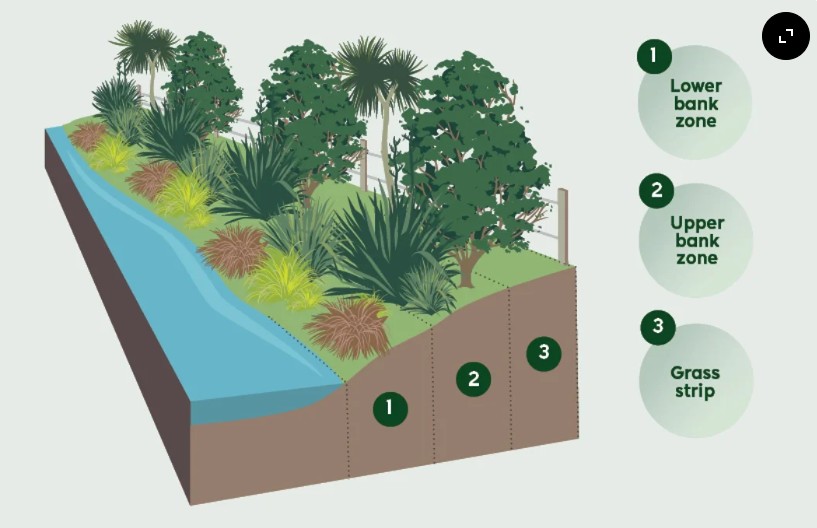
Riparian zones are the areas that border streams and rivers, and other bodies of water like ponds and lakes. There are three main zones:

Lower bank zone – This is the strip of land prone to flooding. Plants must be able to tolerate waterlogged roots and survive many days underwater.

Plant at 1 to 1.5m spacings.

Middle bank zone – This zone is on higher ground but may partially flood every couple of years. Use plant species that can tolerate having damp feet.

Plant at 2.5 to 3m spacings.

Upper bank zone – May partially flood every couple of years. Plant species that prefer dry conditions. If planting on farms, then leave a grass strip at least 1 metre wide.

What are the benefits of riparian planting?

🌡️ Cooler Water Temperatures – Shade from native trees and shrubs helps lower stream temperatures, reducing stress on aquatic life and curbing algal blooms. With temperatures loggers around the catchment indicating a number of streams are above 20 degrees in the summer, the need for shade is clearer than ever.

🛡️ Cleaner Water – Riparian vegetation filters sediment, nutrients, and contaminants before they reach waterways. This improves water clarity and reduces the risk of eutrophication.

🌊 Stronger Banks – Deep-rooted natives stabilise streambanks, reducing erosion and flood damage—especially important after recent storm events across the catchment.

🦎 More Biodiversity – Riparian corridors support native birds, insects, and fish. They act as ecological highways, linking habitats and boosting resilience.

👣 Community Connection – Planting days bring people together. Whether on farms, lifestyle blocks, or public land, riparian planting builds stewardship and shared care for freshwater.
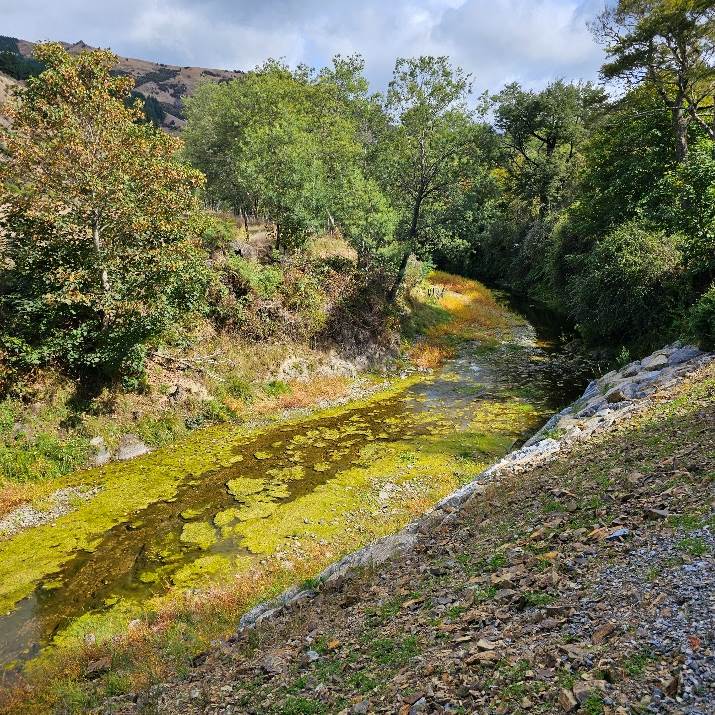

Riparian planting can reduce water temperatures through shading, reducing the chance of summer algal blooms such as this one on the Dove River

What are the best plants for riparian planting?

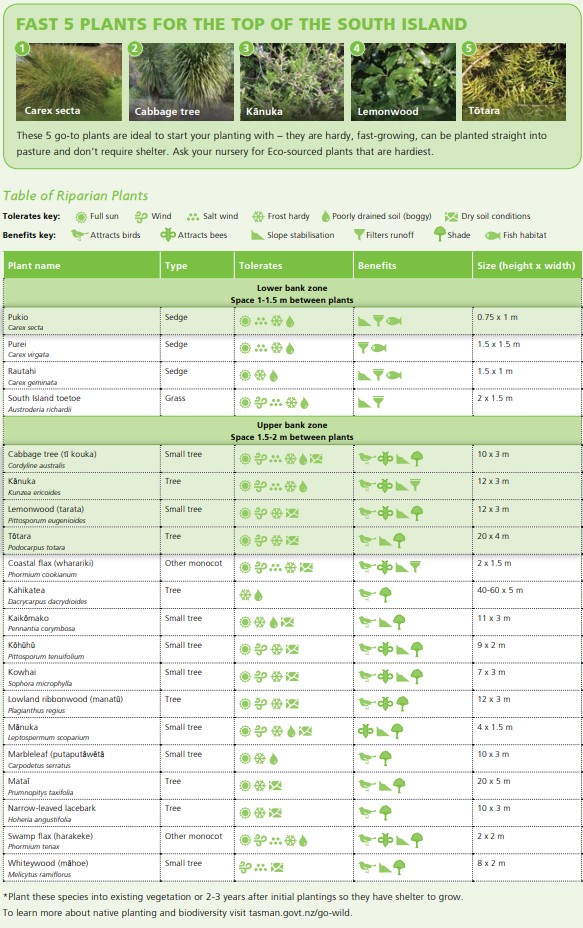
Luckily, guidance has been developed that make suggestions about what to plant where in your riparian zones. This one below is tailored specifically for the top of the South Island. 

It suggests five go to plants to start your planting with. 

Riparian vegetation is an important source of food and energy for aquatic fish and invertebrates. A variety of plants of different species, sizes, and forms and with different leaf shapes should be planted alongside streams to support a diversity of in stream fauna.

Included in the variety should be (Ministry for the Environment (2000):

  • a mixture of species with soft leaves, e.g., wineberry (Aristotelia serrata), tree fuchsia (Fuchsia excorticata), koromiko (Hebe stricta), mahoe (Melicytus ramiflorus) and pate (Schefflera digitata), that break down rapidly, and hard leaves, e.g., titoki (Alectryon excelsus), karamu (Coprosma robusta), lemonwood (Pittosporum eugenioides), kohuhu (Pittosporum tenuifolium), five finger (Pseudopanax arboreus) and kamahi (Weinmannia racemosa), that break down over longer periods;
  • a mixture of species with larger leaves, e.g., wineberry, karamu, tree ferns, five finger and pate, that will stay resident in a section of stream for longer, and small leaves e.g. koromiko, red matipo (Myrsine australis), and kohuhu, that are more inclined to be carried downstream in the current;
  • a selection of shorter lived species, e.g., wineberry, karamu, koromiko and kohuhu, that are more likely to supply important and rapid sources of woody debris to the streams; and trees and shrubs with a weeping habit over stream edges, e.g., toetoe (Cortaderia species), Carex species, flax (Phormium tenax), kowhai (Sophora spp.), native brooms (Carmichaelia spp.) and tree ferns, to supply a variety of terrestrial insects and other invertebrates for fish to feed on.
Native versus non natives

A mixture of native and non-native riparian planting in NZ is sometimes used for specific purposes like bank stabilisation or rapid canopy establishment, but the primary focus for ecological benefits should be native species. While some fast-growing non-natives, like willows and poplars, can be used as a first-stage for bank stabilisation or rapid shelter, they should ideally be replaced by or supplemented with natives for long-term benefits to biodiversity and water quality. It is crucial to use eco-sourced natives – plants that are naturally found in the local area – to avoid introducing invasive species, and to source them from specialist nurseries to avoid garden hybrids

  • Avoid invasive species:  Be careful to avoid non-natives that could become invasive, such as some species of Hoheria or North Island kowhai, which can hybridise with local South Island varieties
Native planting considerations
  • Eco-sourcing is essential:  Always use native plants that are naturally suited to the local environment and its specific growing conditions. 
  • Source locally:  Find a nursery that specializes in eco-sourced, local plants for the best results. 
  • Avoid garden varieties: Do not use garden cultivars bred for appearance, as they may not be as resilient or beneficial in a riparian restoration context. 
  • Prioritize native species for long-term health:  Long-term benefits such as biodiversity and water quality are best achieved with native species. Using non-natives for the initial planting is a temporary measure. 

🌱 How to Prepare for Winter Planting

There are key steps you can follow when planting riparian zones or wetlands. Start with getting to know your waterways and preparing a planting plan. Next complete your site preparation and plantings then finish with the ongoing maintenance and weed control.

  • Walk your stream: Identify wet vs dry zones, steep banks, and areas prone to flooding. This will guide species selection.
  • Fence first: Livestock exclusion is essential before planting.
  • Order early: Eco-sourced natives are in high demand—book now for winter delivery.
  • Plan your zones:
    • Lower bank: Use Carex, harakeke, and toetoe—plant 1–1.5m apart.
    • Middle bank: Wineberry, tree fuchsia, and koromiko—plant 2.5–3m apart.
    • Upper bank: Five finger, kohuhu, lemonwood—leave a grass buffer if near pasture

How wide does my riparian planting need to be?

Research has shown that larger buffers provide bigger benefits.

Natural riparian zones typically extend from the stream edge, across the floodplain to the base of the hills, and in steeper catchments part way up the slopes. The productive value of stream margins and flood plains from a farming perspective makes the restoration of the full riparian zone to native trees and shrubs impractical and unaffordable. However, the wider the zone restored to natives the greater its value is likely to be for native terrestrial flora and fauna. Longer, continuous patches of bush provide safer habitat and passage for more native invertebrates (and possibly reptiles too) than do patches separated by non-native vegetation.

Research has shown that there are significant differences in microclimate extending at least 20 metres into an area of bush from the bush edge compared to forest interior (Norton 2002). This is termed “edge effect”. Wind speed, temperature and humidity fluctuate more widely close to the bush edge with the result that the conditions in this edge environment are unsuitable for the natural establishment and growth of some forest interior species. Consequently, unless the restored riparian margin can be made 40 metres wide or more (which in most cases will be impractical) then the impact of edge will have an effect on the suitability of the site for plant species more suited to a forest interior and on the likelihood of natural regeneration of these species occurring.

 The critical role of shading that streamside trees provide

Riparian planting provides shade which creates many benefits; such as reduced water temperatures, less weed and algae growth, and improved aquatic habitats. For these benefits to be fully achieved, rivers require a minimum of 70 percent shade coverage. When deciding what to plant and how wide the riparian margin should be, it’s crucial to consider the orientation of the waterway.

The re-establishment of effective shade is one of the most important steps to restoring healthy habitat for indigenous aquatic invertebrates and fish. Shade levels of 70% or better, when created by trees and shrubs, will:

  • restrict the growth of aquatic plants and algae even if the water contains moderately high nutrient levels;
  • lower peak summer water temperature to levels that can be tolerated by sensitive stream invertebrates and native fish if the shaded portion of the stream is long enough; and provide an important source of food and energy (organic carbon) to aquatic animal life.

A good measure of how much shade is needed is the amount required to keep mid-summer water temperatures to 20° C or lower. This is likely to be sufficient to protect sensitive invertebrate species such as stoneflies and mayflies (Collier et al. 1995) and provide more tolerable conditions for native fish. In narrow headland streams shade provided by stream banks and overhanging bank sedges may be sufficient to keep water temperatures low, but taller shade vegetation is necessary to lower water temperature in larger streams. Greater reward for effort and cost will be achieved by cooling upstream reaches of streams rather than attempting to cool a warm downstream reach.

Reducing sediment through planting

Low sediment concentration  in stream water is important if habitat suitable for many of our native fish and invertebrates is to be created. In catchments prone to soil erosion very effective grass/sedge filters will need to be established and the retention of streambank grasses and sedges may be necessary.

With time, species composition along riparian areas will change especially where increasing shade from overtopping trees and shrubs occurs. Ground covers of lightdemanding grasses, sedges and rushes are likely to be replaced by shade-tolerant species such as ferns.

Shading of 70 % or more is likely to eliminate the sedges and grasses growing on the streambanks which in turn may lead to an increase in sediment generation as the banks erode. Ultimately the banks will revert to a more stable shape but if keeping sediment levels low is a primary objective for stream restoration then the amount of shade created may need to be reduced to around 50% to sustain sedges and grasses on the stream banks.

🌿 Local Success Stories

  • Profile a riparian planting project…. 
  • In 2024, over 14,000 native plants were distributed to more than 40 landowners, supporting riparian and wetland restoration.
  • During the Queen’s Jubilee, MCC partnered with Trees That Count to deliver 8,000 native trees across 11 sites—from lifestyle blocks to working farms.

Whether you’re just starting or continuing a long-term restoration journey, riparian planting is one of the most effective ways to protect freshwater and biodiversity. MCC is here to support you—reach out for advice, resources, or to join upcoming planting events.

For full guidance, visit the Riparian Planting page.

Great resources about riparian planting

https://www.dairynz.co.nz/media/to4n0geg/riparian-management-guide-top-of-the-south.pdf

https://www.dairynz.co.nz/media/to4n0geg/riparian-management-guide-top-of-the-south.pdf

Sources for this article:

https://www.canopy.govt.nz/plan-forest/why-plant-trees/waterways/plant-waterways

https://www.canopy.govt.nz/plan-forest/why-plant-trees/waterways/riparian-zone

https://www.canopy.govt.nz/assets/content-blocks/downloads/Riparian-planting-around-headwaters.pdf

https://www.tanestrees.org.nz/site/assets/files/1069/9_3_for_aquatic_and_terrestrial_biodiversity-1.pdf